I’ve learned from running kids’ parties that the real challenge is not choosing games—it’s managing energy. When I plan a party, I focus on how kids move through different emotional and physical states, from arrival excitement to post-cake sugar crashes.
In this guide, I organize 29 kids’ party games based on age suitability, energy level, group size, setup effort, and play time. I use this structure to design smooth party flow instead of random activities that burn out too quickly or create chaos.
Save this for later
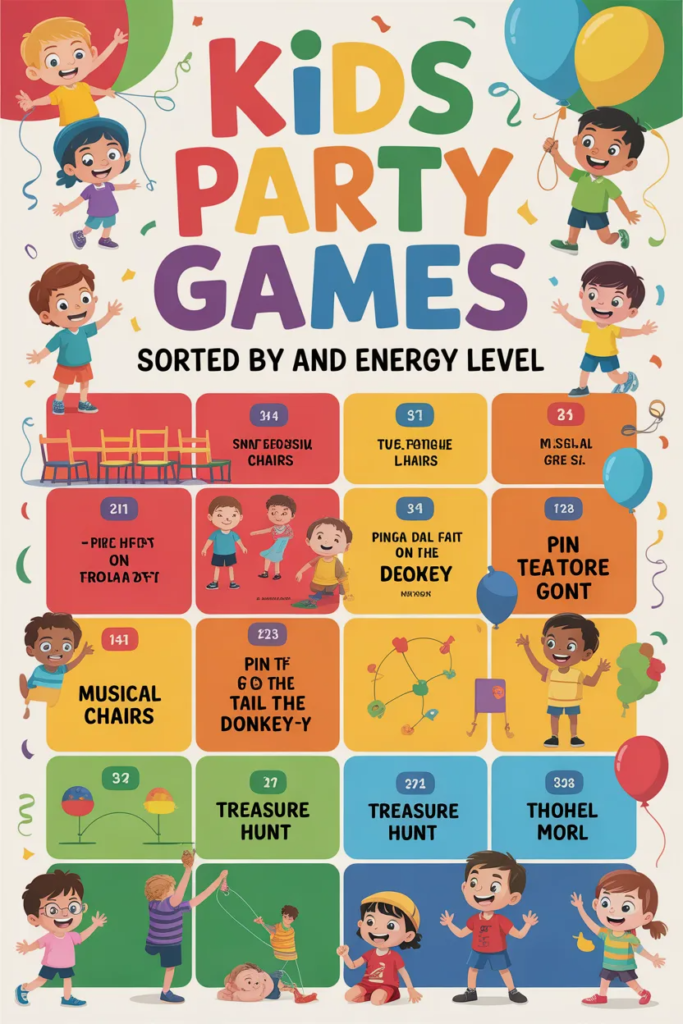
My approach is simple: I start with flexible entry games, build up to high-energy movement games, and then bring everything down with calm activities before food and cake. This prevents overstimulation and keeps the party under control.
Key Takeaways
- I always plan games around energy flow, not just age groups
- I limit most parties to 3–5 structured games in total
- High-energy games work best in the middle of the event
- Calm games are essential to avoid post-cake hyperactivity
- Most games can be done with low-cost or household items
Related artilce: Laugh-Out-Loud Birthday Party Games for Kids
How I Use This List in Real Parties
When I plan a party, I don’t pick games randomly. I build a timeline. First, I use simple or medium-energy games as kids arrive so no one feels left out.
Then I move into high-energy games where kids can run, compete, and release excitement. Finally, I switch to calm, structured games that help settle the group before food or cake.
Each game in my system is tagged with five planning factors: age range, energy level, group size, setup time, and play duration. This helps me avoid overplanning and keeps everything running smoothly even if kids get unpredictable.
High-Energy Kids Party Games (Burn It Off)
1. Balloon Stomp
This is one of my most effective early-party energy burners. I tie a balloon to each child’s ankle and let them try to pop others while protecting their own.
I’ve found this works best with kids aged 5–12 in medium to large groups. The game naturally creates movement, laughter, and competition. I often hide candy inside balloons so even eliminated kids leave happy instead of disappointed.
2. Freeze Dance
This is my go-to arrival game because it requires zero setup. I play music and let kids dance freely, then stop it randomly so they must freeze instantly.
I usually remove elimination for younger kids because the goal is inclusion, not winning. It works perfectly while guests are still arriving and settling in.
3. Relay Races (Pick Your Chaos)
I use relay races when I want structured competition with high movement. Kids split into teams and race using different challenges like spoon balancing, sack hops, or balloon knee-walking.
I rotate race types every few minutes to prevent boredom. This keeps the energy high without letting chaos take over.
4. Musical Chairs
This is a classic elimination game, but I adjust it depending on the group. Kids walk around chairs while music plays and scramble for seats when it stops.
I sometimes let eliminated players control the music so they still feel involved. This small change reduces frustration and keeps engagement high.
5. Capture the Flag (Backyard Version)
I use this for larger outdoor parties with older kids. Two teams hide and protect their flags while trying to capture the opponent’s.
In my experience, this game naturally fills 20–30 minutes and works best when boundaries are clearly explained. Without structure, it can turn into confusion, so rules matter.
6. Obstacle Course
This is one of my highest-effort but highest-reward games. I build simple challenges using household items like chairs, cones, and hoops.
Kids crawl, jump, and balance through the course while I sometimes time them for competition. I’ve noticed kids often repeat it multiple times, which makes setup worth the effort.
Medium-Energy Kids Party Games (Fun Without the Frenzy)
7. Hot Potato
I use this game when I want controlled movement with music. Kids pass an object around a circle, and whoever holds it when music stops is out.
Sometimes I switch the object with a wrapped prize so eliminated kids still stay engaged through unwrapping layers.
8. Pass the Parcel
I rely on this for younger groups because it guarantees fairness. A wrapped gift is passed around, and each layer contains a small reward.
Every child gets something, which reduces emotional reactions when someone doesn’t win the final prize.
Also read: Clever Outdoor Park Birthday Party Ideas
9. Charades
This is one of my most flexible games. Kids act out words or ideas while their team guesses within a time limit.
I adjust difficulty based on age, keeping animals and actions for younger kids and adding movie or character themes for older groups.
10. Limbo
I use a simple stick or pole and gradually lower it as kids pass underneath. The challenge is staying flexible without falling or touching the bar.
What I like most is how naturally funny it becomes, especially when kids start exaggerating their movements for attention.
11. Scavenger Hunt
This is one of my most structured and time-controlled games. I hide clues around the house or yard that lead to a final prize.
I prepare everything the night before so the game runs smoothly. A well-planned scavenger hunt can easily fill 20–25 minutes of focused activity.
12. Duck, Duck, Goose
This is a simple circle game where one child taps others and eventually chooses a “goose” to chase them.
I mainly use this for younger children because it requires no explanation and very little structure.
13. Simon Says
This is my reset game when energy becomes too high. Kids follow commands only when “Simon says” is included.
It helps me regain control of the room quickly while still keeping kids engaged.
14. Pin the Tail on the Donkey
I adapt this to match party themes like superheroes or animals. Kids are blindfolded, spun, and asked to place a piece on a poster.
It’s simple, predictable, and works well when I need a calm, structured activity.
15. Musical Statues
This is similar to Freeze Dance but more creative. When music stops, kids must hold dramatic poses instead of just freezing.
I use this when I want less competition and more laughter-based participation.
Calm-Down Kids Party Games (Wind It Down Before Cake)
16. Memory Tray Game
I place several objects on a tray and let kids study them briefly before covering it. They then try to recall as many as possible.
This is one of my best tools for slowing energy before cake because it forces focus and silence.
17. Who Am I?
I place character names on kids’ backs and they ask yes/no questions to figure out their identity.
It works especially well for mixed groups because it encourages interaction without physical activity.
18. Would You Rather
I ask kids fun either-or questions and let them move to different sides of the room based on their choice.
This keeps things calm while still allowing movement and laughter.
19. Wink Assassin
One child secretly “eliminates” others by winking, while a detective tries to identify them.
I only use this with older kids because it requires focus and self-control.
20. Telephone
Kids whisper a phrase down a line and compare the final version to the original.
The humor comes from how much the message changes by the end.
Games That Work for Mixed Ages (When Siblings Tag Along)
21. Piñata
I use this when I have mixed age groups because it creates shared excitement.
Younger kids go first, while older kids are blindfolded or challenged to make it fair.
22. Treasure Hunt With Buddy Teams
I pair older and younger kids together so both feel included.
Older kids help read or guide while younger kids focus on finding items.
23. Bubble Station
This is my fallback activity for toddlers or overwhelmed kids.
It’s not structured but works as a calming, low-pressure play zone.
Minute-to-Win-It Party Games (Fast, Loud, and Hilarious)
24. Cup Stack
Kids race to build and collapse cup pyramids as fast as possible.
It’s simple, competitive, and easy to reset for multiple rounds.
25. Cookie Face
Kids try to move a cookie from forehead to mouth using only facial movements.
It always produces laughter and keeps the atmosphere light.
Check this: Park Birthday Party Ideas That Work In Any Weather
26. Donut on a String
Kids race to eat hanging donuts without using their hands.
It’s messy but extremely engaging for outdoor setups.
27. Balloon Waddle
Kids walk while holding a balloon between their knees.
The instability makes it fun and unpredictable every time.
Two Bonus Classics That Never Fail
28. Saran Wrap Ball Game
I wrap small prizes in layers of cling film and let kids unwrap them while dice control turns.
It creates suspense because prizes appear randomly during the game.
29. Pirate Treasure Dig
I hide small toys in sand or rice and let kids dig for treasures.
This works especially well for younger children who enjoy sensory play.
FAQ
How many games do I need?
I consistently use 3–5 structured games per 2-hour party. More than that usually reduces attention quality.
Best games for small groups?
I rely on charades, memory games, and pass-the-parcel style activities because they don’t depend on large teams.
How do I prevent kids crying when they lose?
I design games where everyone receives something—either through participation rewards or layered prizes.
What games need no supplies?
Freeze Dance, Simon Says, Duck Duck Goose, and Telephone are my zero-prep go-to options.
Indoor vs outdoor games?
Most games work in both environments, but I avoid large running games indoors unless space is controlled.