Planning a toddler birthday party can feel harder than planning an event for adults. I’ve learned that most toddlers don’t care about elaborate decorations or expensive entertainment. What they really enjoy is moving around, exploring, laughing, and spending time with friends.
The biggest mistake many parents make is trying to schedule too many activities. Research shows toddlers typically focus on one activity for only 4 to 6 minutes before wanting something new. That’s why simple, flexible games usually work better than complicated plans.
Save this for later
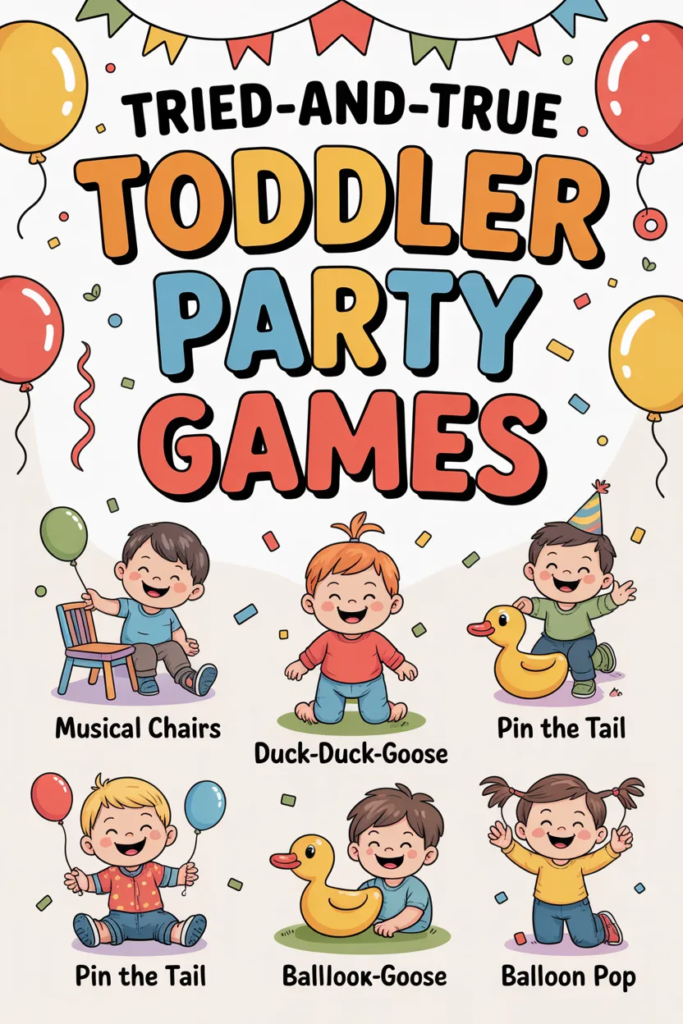
In this guide, I’m sharing toddler party games that have consistently worked at birthday parties, playdates, daycare events, and family gatherings. These activities require minimal setup, fit different budgets, and help avoid the meltdowns that can happen when children become bored or overwhelmed.
Key Takeaways
- Most toddler parties only need 5 to 6 planned activities.
- Games without winners and losers reduce frustration and tears.
- Movement-based activities help toddlers burn energy naturally.
- Sensory and creative stations provide important quiet-time breaks.
- Simple games often perform better than expensive entertainment.
- Flexible scheduling works better than strict timelines.
- Parent participation can significantly improve engagement.
Related article: Outdoor Birthday Party Ideas for Kids That Cost Almost Nothing
1. Freeze Dance
Freeze Dance remains one of my favorite toddler party activities because it requires almost no preparation. All I need is music and enough space for children to move safely. The rules are simple enough that even younger toddlers can join in.
When the music plays, everyone dances. When it stops, everyone freezes. Instead of eliminating children who move, I simply restart the music and keep the fun going. This approach keeps the atmosphere positive and inclusive.
Pro Tip: Create a playlist with songs lasting 60 to 90 seconds. Short rounds help maintain attention and excitement throughout the game.
2. Bubble Popping Frenzy
Whenever I’m unsure what activity to start with, bubbles rarely disappoint. Many child development specialists recommend bubble play because it encourages movement, hand-eye coordination, and visual tracking skills.
A bubble machine works best for larger groups because it creates a constant stream of bubbles without requiring an adult to stop and refill every few minutes. Children naturally run, jump, and reach without needing instructions.
For outdoor parties, I like to have extra bubble solution available. Most standard machines run continuously for around 15 to 20 minutes before needing a refill.
Pro Tip: Set the bubble machine slightly above toddler height. This creates more floating bubbles and gives children additional opportunities to chase them.
3. Treasure Hunt (The One Game Worth Over-Preparing)
If I had to choose only one structured activity for a toddler party, it would be a treasure hunt. It combines exploration, movement, and small rewards, making it one of the few games that can hold toddlers’ attention longer than usual.
Unlike competitive games, every child reaches the final prize together. That simple detail helps eliminate disappointment and encourages teamwork.
How to Set It Up
I keep the setup straightforward and focus on locations toddlers already recognize.
You’ll Need:
- Picture clues
- Small treats or stickers
- A box or basket
- Small prizes
- Tape for placing clues
Start by selecting 5 to 6 locations around your home or yard. Create picture-based clues rather than written ones. Most toddlers respond much better to visual prompts than text.
At each location, place a small reward. The final stop should lead to a treasure box containing enough goodies for every child.
Common Mistakes to Avoid
The most common mistake I see is hiding clues too well. Toddlers can become frustrated quickly if they can’t find something within a minute.
Another issue is creating a route that’s too long. Five or six stops usually provide the right balance between excitement and attention span.
Why This Works So Well
This activity taps into three things toddlers naturally enjoy:
- Exploring new spaces
- Finding hidden objects
- Receiving immediate rewards
Parents often become involved too, which helps keep younger children engaged from beginning to end.
Cost Reality
Most treasure hunts can be created for less than $15 using dollar-store supplies, stickers, and small party favors.
Pro Tip
I recommend pairing younger toddlers with a parent or older sibling. This creates a smoother experience and helps every child stay involved.
4. Pass the Parcel
This classic party game continues to work because it builds anticipation without requiring complicated rules. I wrap a small gift in multiple layers of paper and place a tiny surprise between each layer.
Children sit in a circle while music plays. When the music stops, the child holding the parcel removes one layer and discovers a small reward.
For toddler parties, I avoid competitive versions entirely. Every layer should contain something fun so every child feels included.
Ideas for Layer Rewards:
- Stickers
- Temporary tattoos
- Mini bubbles
- Crayons
- Small stamps
This simple adjustment makes the game much more toddler-friendly.
5. Simon Says (Toddler Edition)
Simon Says works best with children closer to age three because they can better understand directions and follow simple commands. I keep instructions easy and focus on actions they already know.
Some examples include:
- Touch your nose
- Jump up and down
- Clap your hands
- Spin around
- Stomp your feet
Rather than eliminating children who make mistakes, I simply continue giving commands. The goal is participation, not competition.
Most toddler groups stay interested for about 4 to 5 minutes, which is perfectly normal.
Pro Tip: Use exaggerated movements and funny voices. Toddlers often respond more enthusiastically when adults look silly.
6. Balloon Bop
Balloons can turn into an instant party activity with almost no effort. I hand each child a balloon and encourage them to keep it from touching the floor.
The beauty of this game is its simplicity. There are no scores, no teams, and no complicated instructions.
Children naturally begin creating their own challenges, whether they’re tapping balloons overhead, chasing drifting balloons, or working together to keep several in the air.
For safety, always remove broken balloon pieces immediately and supervise closely, especially around younger toddlers.
Pro Tip: Inflate extra balloons before guests arrive. It’s common to lose a few during active play.
7. Obstacle Course
Obstacle courses are excellent for toddlers because they encourage movement without creating pressure to compete. I typically use household items I already have rather than purchasing special equipment.
Simple obstacles can include:
- Walking through hula hoops
- Crawling through tunnels
- Stepping over pool noodles
- Tossing soft balls into baskets
- Walking around cones
Children enjoy repeating the course multiple times, often inventing new ways to complete it.
According to pediatric activity recommendations, toddlers benefit from at least three hours of physical activity spread throughout the day. An obstacle course helps support that goal while keeping the party entertaining.
Pro Tip
Create wide pathways and leave plenty of space between obstacles. Toddlers need room to move safely and confidently.
8. Pin the Tail on the Donkey (Or Anything Else)
This party favorite can easily be adapted for younger children. Instead of using a blindfold, I encourage toddlers to close their eyes briefly while a parent gently guides them toward the poster.
Theme-based versions often make the game even more exciting. Depending on the party theme, you can use:
- Pin the horn on the unicorn
- Pin the crown on the princess
- Pin the rocket on the spaceship
- Pin the bone on the puppy
Toddlers are usually more interested in placing the sticker than winning the game, which makes this activity naturally low-pressure.
Pro Tip: Use reusable adhesive dots instead of tape. They make it easier for little hands to place pieces without frustration.
9. Duck Duck Goose
Duck Duck Goose has been around for generations because it’s easy to learn and gets kids moving. I find it works best with toddlers who are at least three years old and understand basic turn-taking.
Children sit in a circle while one child walks around gently tapping heads and saying “duck.” When they choose someone as the “goose,” both children run around the circle before trying to claim the empty spot.
Don’t worry if the game becomes a little messy. With toddlers, the goal isn’t perfect rules. The fun comes from running, laughing, and participating together.
Pro Tip: Keep the circle small so younger children don’t have to run long distances.
10. Sensory Bin Station
Every toddler party needs at least one quiet activity, and a sensory bin is often my first choice. It gives children a chance to slow down, explore different textures, and recharge between active games.
I usually fill a large plastic container with materials such as dried rice, dried pasta, kinetic sand, or pom-poms. Then I hide small toys, plastic animals, or colorful objects for children to discover.
Sensory play supports fine motor development while also helping many toddlers regulate their emotions. It’s one of the few activities that can keep children engaged without requiring constant adult direction.
Pro Tip: Place a sheet or tarp underneath the bin to make cleanup much easier afterward.
11. Egg and Spoon Race
This classic race can be adapted for almost any toddler age group. For older toddlers, I use hard-boiled eggs. For younger children, plastic eggs or lightweight balls work much better.
Each child receives a spoon and balances the object while walking toward a finish line. The object usually falls several times along the way, but that’s often what makes the game funny.
The activity helps develop balance, coordination, and concentration without feeling like a learning exercise.
Pro Tip: Keep the race distance short, around 8 to 10 feet, to match toddler attention spans and skill levels.
Also read: Jurassic Park Birthday Party Ideas That Feel Like the Real Park
12. Ring Toss
Ring Toss is a simple station game that works especially well when you have children arriving at different times. It doesn’t require everyone to participate at once, which makes it useful during party transitions.
I either use an inexpensive ring toss set or create one using cardboard tubes and lightweight rings. Toddlers enjoy the challenge of landing a ring, even if it takes several attempts.
This activity helps improve hand-eye coordination and gives children a chance to practice aiming skills in a low-pressure setting.
Pro Tip: Move the throwing line closer for younger toddlers so they can experience success more quickly.
13. What’s the Time, Mr. Wolf?
This game combines movement, anticipation, and a little bit of playful suspense. One adult or older child acts as the wolf while everyone else stands several feet away.
Children ask, “What’s the time, Mr. Wolf?” The wolf responds with a number, and everyone takes that many steps forward. At some point, the wolf suddenly shouts, “Dinner Time!” and turns around to chase the players.
The excitement builds with every round, which is why many toddlers stay interested longer than expected.
Pro Tip: Having an adult play the wolf usually keeps the game running smoothly and prevents disagreements over turns.
14. Parachute Games
A play parachute is one of the most versatile party supplies I’ve used. It encourages teamwork, movement, and group participation while being suitable for a wide range of ages.
Three activities consistently work well:
Mushroom
Everyone lifts the parachute high into the air and quickly brings it down. The parachute fills with air and creates a giant mushroom shape that toddlers love.
Popcorn
Place lightweight balls on top of the parachute and have everyone shake it. The balls bounce around unpredictably, creating lots of excitement.
Under the Sea
Children gently wave the parachute while one or two kids crawl underneath. Rotating turns helps everyone stay involved.
Pro Tip: A six-foot parachute usually works well for groups of 8 to 10 toddlers.
15. Cookie Decorating Station
When I need an activity that also doubles as a snack, cookie decorating is usually my answer. It combines creativity, fine motor skills, and a sweet reward at the end.
Give each child a plain cookie, a small amount of frosting, and a few decorating options such as sprinkles or mini candies. There are no rules, which makes the activity enjoyable for a wide range of ages.
Children love showing off their creations, and many parents appreciate having an activity that keeps kids seated for a few minutes.
Pro Tip: Prepare decorating supplies before guests arrive to keep the process simple and organized.
16. Bottom Shuffle Race
This is one of those games that sounds silly but consistently gets laughs from both kids and parents. Children sit on the floor and race from one side of the room to the other using only their legs and bottoms.
The movement feels different from normal running games, which makes it exciting for toddlers. Most children immediately want to try again after the first race.
Since there are no complicated rules, setup takes less than a minute and requires no supplies.
Pro Tip: Use a smooth indoor surface such as hardwood, vinyl, or low-pile carpet for easier movement.
Party Planning Insight
One thing I’ve noticed after attending and organizing toddler parties is that children rarely remember every activity. What they remember is whether they had fun, felt included, and had opportunities to play freely.
According to child development experts, unstructured play is just as valuable as organized games during early childhood. That’s why I always leave space in the schedule for spontaneous fun. Sometimes the most popular activity isn’t the one I planned at all.
17. Animal Parade
Animal Parade is one of the easiest ways I’ve found to fill a few minutes between bigger activities. It gets toddlers moving, encourages imagination, and doesn’t require a single supply.
I simply call out an animal and everyone copies how it moves. We stomp like elephants, hop like rabbits, waddle like penguins, or crawl like bears. The sillier I act, the more excited the children become.
This game also helps younger toddlers participate because there are no winners, losers, or complicated instructions to follow.
Pro Tip: Let birthday kids choose the next animal. It keeps them engaged and gives them a special role during the party.
18. Bowling with Water Bottles
Homemade bowling is one of the most budget-friendly toddler party games. I save a few empty plastic bottles, fill them partway with water, and line them up like bowling pins.
Toddlers take turns rolling a soft ball toward the bottles. They usually care less about scoring points and more about hearing the satisfying crash when the bottles fall over.
The game naturally encourages hand-eye coordination, balance, and turn-taking while still feeling like pure fun.
Pro Tip: Add a few drops of food coloring to each bottle to make the setup more visually exciting.
19. Craft Corner
Every successful toddler party benefits from having a calm activity area, and a craft corner is usually my go-to choice. It provides a break from running games and gives children an opportunity to create something of their own.
I like to set out crayons, stickers, paper shapes, glue sticks, and washable markers. Simple projects work best because toddlers often enjoy the process more than the finished product.
A craft station also helps children who may feel shy or overwhelmed in larger group activities.
Pro Tip: Pre-cut shapes and materials before the party so toddlers can focus on creating instead of waiting for adult help.
20. Scavenger Hunt (Picture Version)
Unlike a traditional treasure hunt, a picture scavenger hunt allows children to search at their own pace. This makes it especially useful for mixed-age groups and children with different personalities.
I create a simple sheet with pictures of common objects hidden around the house or yard. Children mark each item as they find it.
This activity encourages observation skills, movement, and problem-solving while avoiding the pressure of competition.
Pro Tip: Pair younger toddlers with a parent or older sibling to make the experience more enjoyable and less frustrating.
21. Walk the Plank
Walk the Plank is surprisingly simple but always attracts attention. I place a strip of painter’s tape on the floor and challenge children to walk from one end to the other without stepping off.
For many toddlers, balancing on a narrow line feels like a real adventure. Friends and family can cheer them on as they make their way across.
This activity helps build balance, confidence, and body awareness while requiring almost no setup.
Pro Tip: Use multiple tape lines with different shapes and curves to create extra challenges for older toddlers.
22. Sing-Along Circle
As the party starts winding down, I often gather everyone together for a sing-along circle. Familiar songs help bring children back to one place and create a calmer atmosphere before cake or goodbyes.
Songs with actions tend to work best. Favorites often include:
- Wheels on the Bus
- Head, Shoulders, Knees and Toes
- If You’re Happy and You Know It
- Twinkle, Twinkle, Little Star
The movements help maintain attention while allowing children to participate at their own comfort level.
Pro Tip: Keep the session short. Around 10 minutes is usually enough to maintain interest.
23. The Cardboard Box
This may sound like a joke, but some of the most successful toddler parties I’ve attended had one thing in common: a large cardboard box.
I’ve watched toddlers spend more time climbing into boxes, pretending they’re cars, decorating them with crayons, and turning them into imaginary houses than they spent on expensive party entertainment.
A cardboard box encourages open-ended play, which is one of the most valuable types of play for young children. There are no instructions, rules, or expectations. Children simply create their own fun.
Pro Tip: Cut out a few windows and a doorway before the party starts. Those simple additions can turn a basic box into the most popular attraction of the day.
A Quick Note on Party Timing
One lesson I’ve learned over the years is that toddler parties work best when they’re not packed with nonstop activities. Young children need flexibility, snack breaks, and opportunities for free play.
For a typical 90-minute party, I usually follow a schedule similar to this:
Sample Toddler Party Schedule
0–15 Minutes
Arrival time, free play, bubbles, and simple activities.
15–30 Minutes
A high-energy group game such as Freeze Dance or Animal Parade.
30–45 Minutes
Treasure Hunt or Scavenger Hunt.
45–60 Minutes
Cake, snacks, drinks, and a short break.
60–75 Minutes
Activity stations such as Ring Toss, Cookie Decorating, or Sensory Play.
75–85 Minutes
Group activity such as Parachute Games or Bowling.
85–90 Minutes
Sing-Along Circle, party favors, and goodbyes.
I always treat this as a flexible guide rather than a strict schedule. Some activities may run longer than expected, while others may end after only a few minutes. That’s completely normal when toddlers are involved.
Check this: Park Shelter Birthday Party Ideas That Look Way More Expensive
Final Thoughts
After planning multiple toddler birthday parties, I’ve found that the simplest activities are often the most successful. Children don’t need expensive entertainment or perfectly organized schedules to have fun.
What matters most is creating opportunities for movement, exploration, creativity, and connection. If you choose a handful of games from this list and stay flexible throughout the party, you’ll already be setting yourself up for a successful celebration.
Remember, toddlers rarely judge whether a party goes according to plan. They’re much more interested in having fun with the people around them.
FAQ
What are the best toddler party games for a small indoor space?
Some of my favorite options for smaller spaces include Freeze Dance, Pass the Parcel, Simon Says, Sing-Along Circle, and Sensory Bin activities. These games require very little room and can be adapted to almost any home.
How many games do I need for a toddler birthday party?
I typically plan five or six activities but expect to use only three or four. Toddlers often spend more time eating, exploring, and playing freely than adults anticipate.
What toddler party games work for mixed ages?
Bubble play, Treasure Hunts, Scavenger Hunts, Balloon Bop, Craft Corners, and Cookie Decorating Stations usually work well for a range of ages. Older children can participate more independently while younger children still enjoy the experience.
How do I keep toddlers engaged during party games?
Short activities tend to work best. Most toddlers stay focused for only a few minutes at a time, so I rotate games frequently, offer lots of encouragement, and avoid forcing participation.
Do I need prizes for toddler party games?
Not necessarily. Many toddlers are happy simply participating. However, inexpensive rewards such as stickers, stamps, mini bubbles, or temporary tattoos can add excitement and help create positive memories.
What is the ideal length for a toddler birthday party?
For most toddlers, 60 to 90 minutes is plenty. Longer parties can lead to overtired children and increased chances of meltdowns, especially for younger guests.
Should every game have a winner?
In my experience, toddler parties run much more smoothly when activities focus on participation rather than competition. Cooperative games create a more positive environment and reduce frustration among young children.
What should I do if toddlers lose interest in a planned activity?
Move on without hesitation. Flexibility is one of the most important parts of hosting a toddler party. If an activity isn’t working, switch to something else or allow free play for a few minutes.