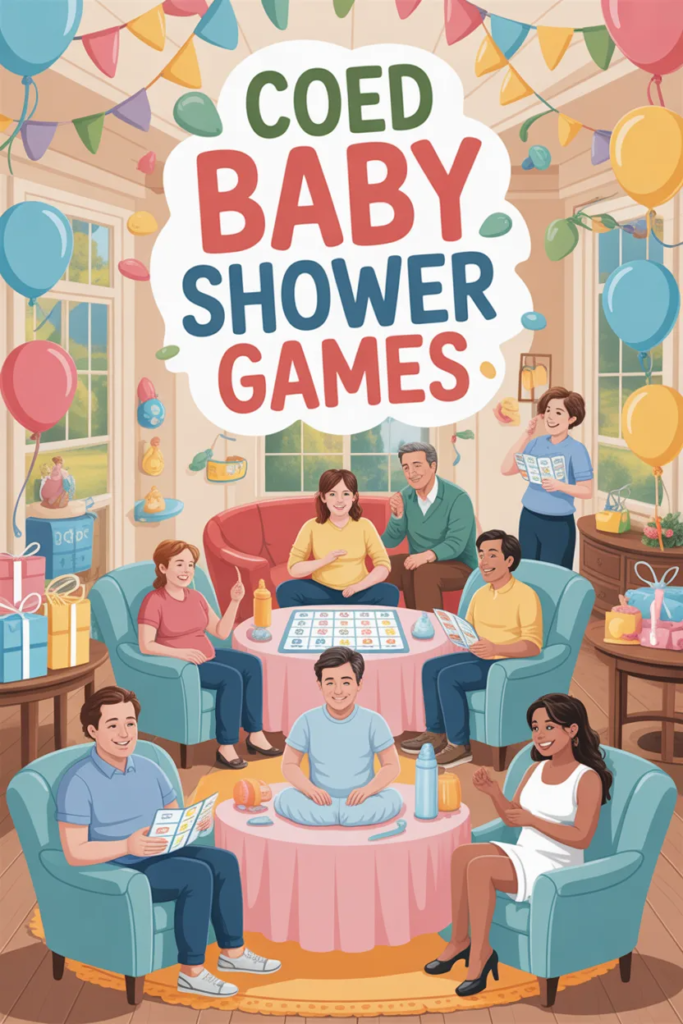
I break down 21 coed baby shower games designed to keep both men and women engaged without awkward downtime or forced participation. These games range from fast icebreakers to competitive group challenges and low-prep printable activities. I focus on what actually works in real parties: simple rules, low setup, and natural competition. From “My Water Broke” to DIY Diaper Pong and stroller races, each idea is built to keep energy high and guests involved. The goal is a shower where people stay, play, and actually enjoy themselves.
Save this for later
Key Takeaways
- I use games that rely on competition, humor, or physical activity—not baby knowledge
- Most games cost under $10 or require zero setup
- A mix of passive + active + anchor games keeps energy stable
- Tournament-style formats work best for large groups (20–40+ guests)
- The strongest engagement comes from games with instant rules and fast payoff
Related article: Open House Baby Shower Ideas
Introduction
I’ve noticed coed baby showers fail for one simple reason: the games are built for one type of audience. When men show up, anything slow, overly sentimental, or complicated loses them immediately.
The solution I’ve found is to focus on mechanics that feel like party games first and baby shower games second. Competition, speed, and simple rules keep everyone involved without forcing it.
Below is a breakdown of 21 games I consider reliable for mixed groups, based on cost, setup time, and how well they actually hold attention in real events.
1. My Water Broke
I like this game because it runs on its own without any host effort. Frozen plastic babies are placed in drinks, and the first guest whose ice melts shouts “My water broke.”
The engagement comes from passive anticipation. Guests keep checking their drinks throughout the event. The average setup cost stays under $6 for a bulk pack of small plastic babies, making it one of the cheapest high-impact games.
2. Baby Bump or Beer Belly?
I use cropped belly images where guests guess whether the silhouette belongs to a pregnant woman or not.
It works well as a walk-in activity because it requires no instructions. Printing individual sheets prevents copying and keeps participation independent, which increases completion rates during arrival time.
3. He Said / She Said
I collect answers from both parents beforehand and turn them into a guessing game for guests.
The strength of this game is emotional contrast. Guests argue over how the couple “should” answer parenting questions, which creates natural debate without needing rules complexity. It takes about 30–45 minutes to prepare but no effort during the event.
4. Baby Gift Bingo
I ask guests to predict what gifts will appear before gift opening starts.
Each match earns points. This keeps attention focused during gift opening, which is usually the slowest part of any shower. It also turns passive watching into active prediction, improving engagement without adding time pressure.
5. DIY Diaper Pong — Anchor Game
This is the central competitive game I rely on for most coed showers.
It works because it borrows familiar mechanics from beer pong but replaces alcohol with baby-themed visuals. The triangular “diaper” formation creates structure, while tournament brackets keep people rotating.
For larger groups (20+ guests), I always run it as a bracket system instead of a single match. A full DIY setup usually stays within $40–60.
6. Baby Bottle Chug
I use baby bottles filled with drinks and make guests compete to finish first.
The difficulty comes from the nipple design, which slows down even experienced drinkers. That unexpected resistance is what makes it entertaining to watch. Non-alcoholic versions work just as well.
7. The Baby Photo Lineup
Guests submit childhood photos before the event, and I print them for a matching game.
This game performs well because it removes baby-related knowledge entirely. Success depends on observation skills instead. For groups above 20 people, I always duplicate the display board to avoid crowd bottlenecks.
8. Baby Food Taste Test — What Most Hosts Get Wrong
I’ve seen this game fail often because participation is assumed, not guaranteed.
When I run it, I cap it at five jars and start with familiar flavors like banana and sweet potato. I also include one surprise item that isn’t baby food at all to keep reactions unpredictable. The focus shifts from accuracy to entertainment.
9. Baby Song Challenge
I split guests into teams and ask them to list songs with the word “baby” in them.
It scales well because there’s no physical setup. Most teams reach 10–15 songs quickly, with “Baby Shark” appearing almost instantly in every group I’ve observed.
10. Shower Squares
I adapt a betting-grid format where guests purchase squares and predict event outcomes.
This works because money introduces natural competition. Guests track results throughout the shower without needing reminders. It’s one of the few games where passive engagement stays consistently high.
11. Dad Jokes Quiz
I ask guests to complete joke punchlines and let the dad-to-be pick winners.
The scoring is subjective, which increases humor variation. I’ve found that removing “correct answers” and focusing on funniest responses improves participation quality significantly.
12. Belly Twister
I use a Twister board with balloons under shirts to simulate pregnancy.
The instability of movement creates natural chaos, especially in tight spaces. It works best with 4–6 players rotating in cycles so everyone gets a turn.
13. Blindfolded Diaper Change Race
Guests race to diaper a doll while blindfolded.
This game levels the field completely. No prior parenting experience matters. In larger groups, I always run it as a relay to keep more people involved instead of limiting participation.
14. Water Balloon Waddle Race
I use water balloons between legs for a simple race format.
The challenge is balance, not speed. It works best outdoors and scales easily without modification for group size.
15. Baby Pictionary
I use baby-related terms like “swaddle” or “diaper blowout” for drawing challenges.
The humor comes from interpretation gaps. Most drawings become abstract quickly, which keeps energy high without needing scoring complexity.
16. Never Have I Ever — Baby Edition
I use a finger-down format with parenting experiences.
This works because it naturally reveals differences in life experience among guests. It requires no setup and adapts easily to any group size.
17. What’s in Your Phone
I turn personal phone data into a point system.
Guests check items like contacts, photos, and apps. It performs well because it turns private data into a light competitive checklist without requiring interaction.
18. Baby Word Scramble
I use scrambled baby-related words as a filler activity.
This works best during arrival or downtime. It keeps early guests occupied while waiting for others to arrive.
19. Decorate a Onesie Station
I provide plain onesies and fabric markers for creative participation.
This is not competitive. I use it as a memory-building activity rather than a game. The finished items often become keepsakes, which adds long-term value beyond the event.
20. Babies Against Parenthood
I use a Cards Against Humanity-style format with baby-themed prompts.
This works best with close friend groups. In mixed or formal settings, I avoid it due to its humor style, which can vary widely in acceptance.
21. Baby Stroller Derby
I set up a simple obstacle course with a stroller and doll.
I often add a diaper-change checkpoint mid-race to increase difficulty. This game works best outdoors where movement space is not restricted.
Read this next: 10 Fun Alternatives to Baby Shower Favors
Closing Thoughts
I design coed baby shower games around one principle: reduce explanation time and increase interaction speed.
When I combine one passive game, one anchor competition like Diaper Pong, and one active group challenge, engagement stays consistent throughout the entire event. This structure works across both small indoor gatherings and larger outdoor parties.
The outcome is simple: guests stay involved without needing reminders, and the celebration feels natural rather than scheduled.